Can SynthID Detect ChatGPT Images?
By Alex | Last Updated: October 2026
Independent information site. Not affiliated with or endorsed by Google or OpenAI. The official detector is at synthid.com.
Often, yes. OpenAI says images made with ChatGPT, Codex and its API carry a SynthID watermark and C2PA metadata, and OpenAI is one of the partners the SynthID Detector recognizes. A clean result still proves nothing, and none of this applies to text written by ChatGPT.
What OpenAI announced
In May 2026 OpenAI joined the C2PA steering committee and said it would add Google DeepMind's SynthID watermark to its images alongside the C2PA Content Credentials it already attached. Per PetaPixel's coverage, that covers images from ChatGPT, Codex and the OpenAI API.
OpenAI also runs a public Verify page. You upload an image, and the tool looks for an OpenAI SynthID watermark or a trusted OpenAI C2PA record. Finding either points to an OpenAI tool. OpenAI says errors with the tool can happen but are rare. The Next Web reports that the page checks audio as well as images, while the coverage of the announcement itself refers to images only.
When the SynthID Detector opened to everyone on October 7, 2026, OpenAI was named as a supported partner alongside NVIDIA and Kakao.
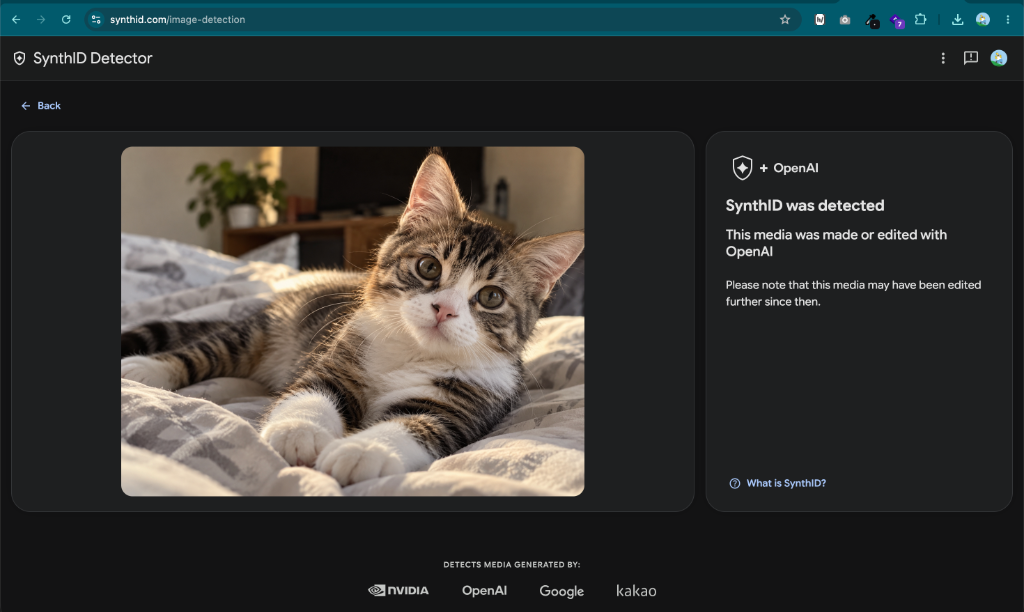
What the SynthID Detector can tell you about a ChatGPT image
| Situation | What to expect | What it means |
|---|---|---|
| A fresh ChatGPT image, original file | Likely detected | A SynthID partner's AI tool made or edited it |
| A screenshot or re-saved copy | May or may not be detected | Google says SynthID usually survives rescaling, recoloring and compression, but detection can fail after many alterations |
| A ChatGPT image edited again in another tool | May still be detected | The result can't say how much of it is AI |
| An older ChatGPT image from before the rollout | Uncertain | Coverage of the announcement doesn't say whether older models add the mark |
| An image from another generator | Probably clean | Not a SynthID partner, or not marked |
| Text written by ChatGPT | Not checked | The public site has no text option |
One caution on wording. Google's sample result says media was made or edited with Google AI. We haven't seen how the panel words a partner's media, so read the exact message on screen rather than assuming it names OpenAI.
How to check a ChatGPT image
- Find the original file. A copy saved from a chat app or a screenshot has been through more processing.
- Run it through synthid.com. See our how-to guide. The quota is about 10 checks a day.
- Try OpenAI's Verify page for the more specific answer. It asks a narrower question: did OpenAI's tools make this?
- Check Content Credentials. Open the file in a Content Credentials viewer. If the metadata survived, it can show the tool and edit history.
- Weigh the results. A positive is strong evidence. A negative is not proof of anything.
Why a ChatGPT image might show nothing
- It is older than OpenAI's rollout, or came from a model that doesn't add the mark.
- The C2PA metadata was stripped by a screenshot, conversion or upload. OpenAI itself says editing, converting or sharing can remove metadata.
- It was edited or recompressed heavily enough to weaken the watermark.
- It never came from ChatGPT at all.
What about ChatGPT text?
The announcements we read cover images and, per The Next Web, audio. They don't describe watermarking ChatGPT's written output. The public detector has no text option anyway, so don't use a SynthID check to judge whether ChatGPT wrote an essay. See our guide for teachers.
A real-world example
PetaPixel reported that a photo competition winner was disqualified after an invisible SynthID watermark was found in their image. It is a reminder that the watermark can surface a fact a person never disclosed, but it is one reported case, not proof of how often this happens.
Questions people ask
Does it detect DALL·E images?
We haven't found a statement about older models such as DALL·E 3. OpenAI's announcement is about images from ChatGPT, Codex and the API. Test the file instead of assuming.
Is OpenAI's Verify page better than synthid.com for ChatGPT images?
It answers a narrower question: did OpenAI make this? synthid.com answers whether a supported partner's SynthID mark is present, whichever partner it was.
Will a screenshot of a ChatGPT image still be detected?
It may be. Google says SynthID usually survives rescaling, recoloring and compression, but detection can fail after many alterations. C2PA metadata usually won't survive a screenshot.
Can a clean result mean it's a real photo?
No. It only means no supported mark was found.