SynthID Detector: Check for AI Watermarks
By Alex | Last Updated: October 11, 2026
Open the official SynthID DetectorThe SynthID Detector is Google's official online portal and AI watermark checker for verifying whether an image, video, or audio file carries SynthID—an invisible cryptographic watermark added by generative AI systems from Google, OpenAI, NVIDIA, and Kakao. Google opened this Google SynthID detector tool worldwide on October 7, 2026. As a dedicated SynthID watermark detector, it checks exclusively for supported watermarking signals rather than relying on probabilistic AI classifier guesses, meaning a clean result simply confirms no supported watermark was found.
- Checks: images, video and audio files
- Detects: SynthID from Google, OpenAI, NVIDIA and Kakao; Apple announced, no date
- Access: free, sign-in with a Google, OpenAI or Apple account, roughly 10 checks a day
- Biggest limit: it finds only SynthID, not AI in general
DETECTS MEDIA GENERATED BY:
SynthID embeds digital watermarks directly into AI-generated images, audio or video. The watermarks are added across generative AI consumer products from the above companies.
Watermarks are imperceptible to humans, but can be detected by SynthID's technology. It is robust against common transformations. When uploading files for detection, please upload the highest quality file possible to ensure maximum detection accuracy.
This is not a general AI detector. We can only detect media from the above companies, who have adopted SynthID technology. We are continuously working on extending our partnerships to allow detecting more generated media.
FAQ
People Also Ask
How to detect SynthID
Google builds SynthID checks into Gemini, Search, Chrome, and the public portal at synthid.com, while OpenAI offers its own verification page. The web tool runs a specialized deep learning model to scan for the imperceptible cryptographic signals embedded in the pixels or audio waveforms.
Does ChatGPT use SynthID?
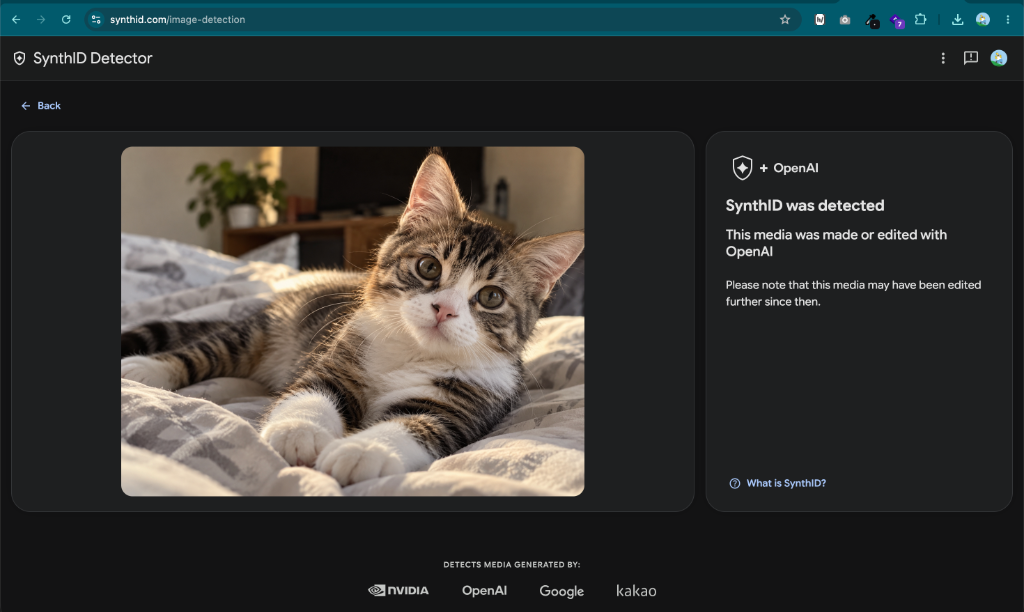
Yes, OpenAI adopted SynthID in May 2026. This means images generated by ChatGPT's DALL-E 3 are watermarked and can trigger a positive match in the detector, though text generated by ChatGPT is not currently supported.
What is SynthID and how does it work?
SynthID is an invisible digital watermarking technology developed by Google DeepMind. It works by subtly modifying a file at the moment of generation—such as imperceptibly altering the pixel distribution of an image or the acoustic waves of audio—in a way that the detector reads.
Can SynthID be removed?
SynthID is designed to survive common edits like cropping, filters and compression. However, Google has said no watermark is foolproof against determined attacks.
Google SynthID Detector: Complete AI Watermark Checker Guide
The SynthID Detector is a free web-based SynthID checker from Google DeepMind that checks whether an image, video, or audio file carries SynthID, an imperceptible watermark embedded by supported generative AI tools. Google opened this official portal worldwide in English on October 7, 2026. Because it operates strictly as a SynthID watermark detector, it cannot tell you whether arbitrary media was generated by AI models that lack SynthID technology.
Independent information site. Not affiliated with or endorsed by Google. The official detector lives at synthid.com.
What Is Google SynthID?
SynthID is an invisible digital watermarking technology developed by Google DeepMind. A compatible generative AI model embeds the mark at the precise moment it generates or edits a file, remaining imperceptible to human eyes and ears. The SynthID Detector is the public verification website that scans uploaded media and determines whether that cryptographic watermark is present.
An early version launched in May 2025 for journalists, media professionals and researchers on a waitlist. The October 2026 release removed the waitlist, so anyone with a supported account can try it. Google says it has watermarked more than 180 billion images and videos since 2023, plus 240,000 years of audio.
How Does SynthID Work?
Unlike heuristic AI detectors, SynthID does not guess whether a file looks artificial based on statistical patterns. Instead, it scans for a deliberate, imperceptible mathematical pattern embedded directly into the file's data layers:
- Images and video: the watermark is built into the pixels at creation. Google designs it to survive cropping, filters, frame-rate changes and lossy compression.
- Audio: the mark is built into the sound itself. Google says it holds up through added noise, MP3 compression and changes in playback speed.
- Text: Gemini text is watermarked by nudging the probability of each word the model picks. The public detector site does not offer a text check, though Google's text watermarking is open source for developers. The text watermark has official limits: it is less effective on short factual responses, and confidence drops if the text is thoroughly rewritten or translated.
SynthID Image Detection, Video Detection, and Audio Detection
Google designed SynthID multi-modally across three distinct digital formats, accepting uploads in standard containers:
| Media | Supported formats |
|---|---|
| Images | JPG, JPEG, PNG, BMP, WEBP, AVIF, HEIC, HEIF, TIFF, TIF, GIF |
| Video | MP4, MOV, WEBM |
| Audio | WAV, MP3, OGG, FLAC, AAC, M4A |
The formats above come from press reports at launch, so confirm them on synthid.com before you rely on them.
Which AI tools it can detect
The detector recognizes SynthID from Google and from partners that adopted it: OpenAI, NVIDIA and Kakao. Google has said Apple support is coming "soon" but has not given a date. Content from companies that use different watermarking, or from open models run at home that add no mark, will not be flagged.
How to Detect SynthID Watermarks Online
- Go to the official site at synthid.com.
- Sign in with a Google, OpenAI or Apple account.
- Upload one image, video or audio file in a supported format.
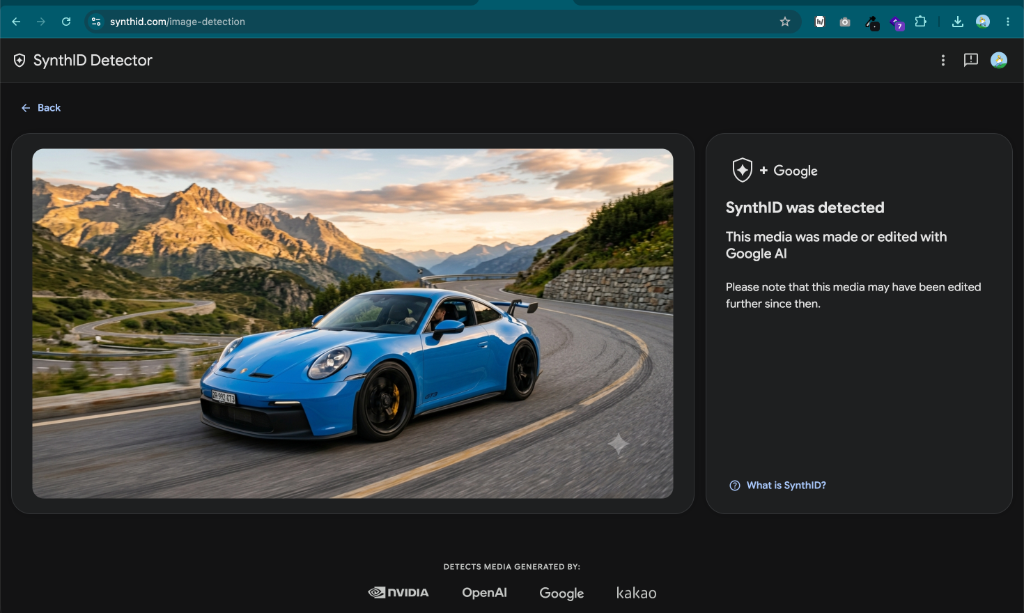
- Read the result. A positive result says the media was made or edited with AI from a SynthID partner and may have been edited since.
Limits you should know
- Daily quota. Google told Ars Technica each user gets roughly 10 image, video and audio checks per day. Google's engineers said the cap exists to stop people from using the tool to build watermark-removal methods.
- Sign-in required. There is no anonymous use.
- A simple answer. The public site gives a yes or no, not the region-by-region highlighting that early testers saw in 2025.
- Generated or edited, you can't tell which. A positive result does not say whether AI produced the whole file or only changed part of it.
- No watermark does not mean real. A clean result only means no supported SynthID mark was found.
Other ways to check
Google also builds SynthID checks into Gemini, Search and Chrome, which together handle over a million verification requests a day. OpenAI runs its own verification page that looks for both SynthID and C2PA signals. For anything high stakes, combine a watermark check with source verification and a reverse image search.
SynthID vs C2PA (Content Credentials)
| Feature | SynthID | C2PA Content Credentials |
|---|---|---|
| What it is | Invisible watermark inside the pixels or audio | Signed metadata record attached to the file |
| Carries | A yes/no signal that a partner tool was involved | Origin, tool used and edit history, when intact |
| Survives screenshots and re-uploads | Often yes, by design | Often no, metadata can be stripped |
| Who it covers | Google and partners that adopted SynthID | Any tool or platform that writes credentials |
The two work best together: the watermark survives when metadata is stripped, and the metadata gives richer detail when it is present.
Is a clean result proof that something is real?
No. The detector answers one narrow question: does this file carry a SynthID watermark from a supported tool? Media from other generators, older files made before a partner adopted SynthID, and heavily altered files can all come back clean. Treat a positive result as strong evidence and a negative result as no evidence either way.
How to read a SynthID result
The result is a simple yes or no about one thing: whether a SynthID watermark from a supported tool is in the file. Here is what each answer does and does not tell you.
| Result | What it means | What it does not mean |
|---|---|---|
| Watermark detected | A SynthID partner's AI tool made or edited the media, and it may have been edited since | Which tool, who made it, whether AI made all of it or only part, or when |
| No watermark found | No supported SynthID mark is in the file | That the file is real. It may come from a tool without SynthID, be an older file, or be heavily altered |
A practical way to check a suspicious file
No single check settles it. Stack the signals and weigh them together.
- Run the file through the SynthID Detector, or ask Gemini, or use the check in Chrome.
- If the file still has its metadata, open it in a C2PA Content Credentials viewer to see origin and edit history.
- Run a reverse image search to find where the file appeared before.
- Check the source: who posted it, when, and whether an original exists.
- Use any score-based AI detector only as supporting evidence, never as proof.
Decide from the whole picture. A positive SynthID result is strong evidence, and everything else is context.
SynthID vs AI Detector: Watermark Checker vs Statistical Classifier
People mix these up. SynthID looks for a mark placed at creation. Classifier-based detectors guess from patterns.
| Feature | SynthID Detector | Classifier-based AI detectors |
|---|---|---|
| How it works | Looks for a hidden watermark added when the file was made | Estimates from patterns whether content looks AI-made |
| Typical output | Yes or no for that watermark | A probability score |
| Coverage | Only tools that adopted SynthID | Tries to cover any generator |
| Main weakness | Misses AI media without the mark | Can be wrong in either direction |
Who it helps, and what a result can prove
| Who | Good use | Limit to remember |
|---|---|---|
| Journalists and fact-checkers | A fast first check on suspicious images, video and audio | A positive result shows AI involvement, not that a story is false |
| Social and content teams | Screening media before it goes into a post or campaign | A clean result is not a clearance |
| Teachers | Checking suspicious images, video or audio | The public site has no text check, so it can't show a student used AI to write, and it should never be the only basis for an accusation |
SynthID Detector timeline
Early 2025
NVIDIA began adding SynthID to videos from its Cosmos preview service
May 2025
Google announced the SynthID Detector portal for early testers on a waitlist
May 2026
OpenAI committed to SynthID alongside C2PA Content Credentials
Oct 7, 2026
Public launch worldwide in English, with Google, OpenAI, NVIDIA and Kakao supported
Announced, no date
Apple support, "coming soon". Google has also said ElevenLabs committed to adding SynthID
Bottom line
Use the SynthID Detector as a fast first check on suspicious images, video and audio, and treat a positive result as strong evidence. Never treat a negative one as a clean bill of health. Bookmark this page: we update it as partners such as Apple come on board.
Frequently Asked Questions
Is the SynthID Detector free?
Yes. It is free at synthid.com, but you must sign in with a Google, OpenAI or Apple account, and each user gets roughly 10 checks per day.
What can the SynthID Detector check?
Images, video and audio files in common formats such as JPG, PNG, WEBP, MP4, MOV, MP3 and WAV. It looks only for the SynthID watermark.
Does it detect images made with ChatGPT?
It can, when the file carries OpenAI's SynthID watermark, because OpenAI is one of the supported partners. The result page also warns that a file may have been edited since the mark was added.
Can it detect Midjourney, Stable Diffusion or other AI images?
Not unless those tools add SynthID. The supported companies are Google, OpenAI, NVIDIA and Kakao, with Apple announced as coming. Anything else can come back clean even when it is AI-made.
Can I check text with the SynthID Detector?
Not on the public website, which has no text option. Gemini text is watermarked with SynthID, and Google has open-sourced the text method for developers.
Does a clean result mean the file is real?
No. It only means no supported SynthID watermark was found. Use it with source checks and reverse image search.
Can it tell whether AI made a whole file or just edited it?
No. A positive result says a compatible AI tool made or edited the media, not how much of it.
Why is there a daily limit?
Google's engineers told Ars Technica the cap makes it harder for people to run repeated tests while building ways to strip the watermark.
Does the SynthID Detector work in other languages?
At launch it is available worldwide in English only, and Google has not announced other languages.
When will Apple support arrive?
Google says Apple support is coming "soon" and has given no date.
Sources
- Google DeepMind: SynthID
- Google blog: SynthID Detector announcement
- Search Engine Journal: Google opens SynthID
- Engadget: Google SynthID Detector AI website
- MacRumors: Google SynthID Detector
- The Next Web: 180 billion images watermarked
- TBreak: Supported formats and daily quota
Guides & Resources
- How to use SynthID Detector: A step-by-step tutorial for checking SynthID watermarks.
- SynthID vs C2PA: Comparing watermark detection vs metadata credentials.
- Limits and daily quota: Understanding the ~10 check daily limit and why it exists.
- Does SynthID detect ChatGPT images?: Find out if you can detect OpenAI media using this tool.
- Detector Alternatives: Gemini, Search, OpenAI's verification page, and C2PA viewers.
- Which AI tools use SynthID?: Google, OpenAI, NVIDIA, Kakao, and upcoming Apple support.
- SynthID for Teachers: Why the detector cannot catch AI-written essays.
- Can SynthID be fooled?: Robustness limits against common edits and adversarial attacks.